
A handheld label printer is a compact, go-anywhere device for creating professional labels on the fly. Forget being tethered to a desk; think of it as your mobile command centre for organisation, giving you the power to tag, track, and identify items instantly, whether you’re on a busy warehouse floor or in a retail aisle.
Picture this: you’re trying to manage a hectic warehouse with new stock flooding in. Without the right gear, you’d be running back and forth to an office printer just to identify pallets, update shelf locations, or track assets. It’s slow, a massive waste of time, and a recipe for mistakes. This is precisely the problem a handheld label printer solves.
These devices are built to fit comfortably in your hand, letting you print tough, clear labels right at the point of need. That immediate, on-the-spot capability is what truly sets them apart from their desktop cousins. You can walk up to a shelf, scan an item, and print a new price tag or inventory label then and there.
The whole idea behind a handheld label printer is to bring the labelling process to the task, not the other way around. For anyone working in an active, constantly moving environment, that freedom is a significant advantage.
This mobility is why they have become so popular. The ever-growing need for sharp, efficient inventory management-especially with e-commerce booming-is driving huge demand for these portable tools. In fact, the UK barcode printer market, which includes these handy devices, is expected to be worth around USD 750 million by 2035.
A handheld printer is like a dedicated assistant for every employee, equipping them with the tools to maintain order and accuracy in real-time. It closes the gap between seeing a problem and fixing it.
By putting this power directly into your team’s hands, you slash wasted motion and significantly cut down on the potential for human error. It is a fundamental tool for any modern, fast-moving operation. For businesses exploring smaller-scale options, our guide on small label printers offers some more focused insights.
Picking the right handheld label printer is not about grabbing the fanciest model off the shelf. It’s about finding the one that genuinely fits the way your business operates day-to-day. After all, a feature that is a lifesaver in a warehouse could be completely redundant in a small retail shop. Understanding the core capabilities is the first step toward making a smart investment.
This image gives a great overview of the main things you will want to look at, from how it prints to how tough it is.
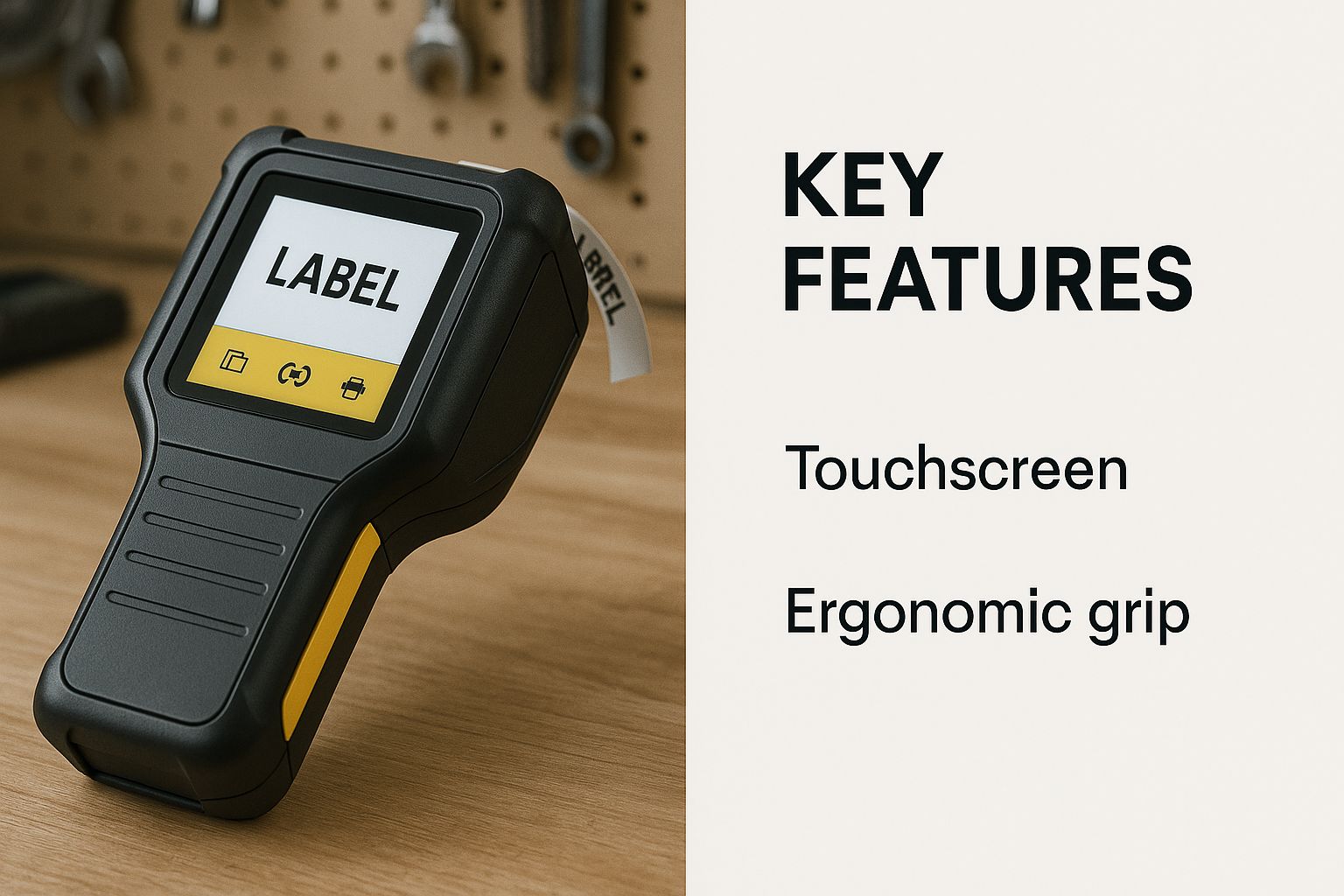
Think of this as a quick reference guide. It shows how the printing method, connectivity, and physical build all come together in one portable tool, helping you focus on what really counts for your team’s workflow.
Your first big decision comes down to the printing technology inside the device. Direct thermal printers are the simpler of the two. They use special heat-sensitive paper, so there are no ribbons or ink to worry about. This makes them brilliant for short-term jobs like shipping labels or receipts, where the label does not need to last for years.
Thermal transfer printers use a heated ribbon to melt ink directly onto the label. The result is an incredibly durable, long-lasting print that can stand up to moisture, chemicals, and sunlight. If you need labels for asset tags, product identification, or anything that has to stay readable for a long time, this is the technology you want.
Then there’s print resolution, measured in dots per inch (dpi). This is all about clarity. For most simple text labels, a standard 203 dpi printer will do the job just fine. But if you’re printing detailed barcodes, tiny fonts, or company logos, you will want to step up to 300 dpi or more to get those crisp, easily scannable results.
A handheld printer is only as useful as its ability to talk to your other systems. Thankfully, most modern devices have gone wireless.
Getting the connectivity right is what transforms a standalone gadget into a part of your operation. It’s no surprise that, beyond their core function, handheld printers are often listed among the top field service tools for improving efficiency across the board.
In any industrial setting-be it a warehouse, a construction site, or a technician’s van-durability is not just a feature; it’s a requirement. You will want to look for an IP (Ingress Protection) rating, which tells you how well the device is sealed against dust and water. A rating like IP54, for example, means it’s protected from dust and can handle splashes, making it reliable in tougher environments.
Also, keep an eye out for a drop-test specification. This tells you, quite literally, how far it can fall onto concrete without breaking. A printer built for the real world will have a rugged case and internal shock absorbers.
Battery performance is just as crucial. A powerful battery, often measured in milliamp-hours (mAh), allows your team to get through an entire shift without stopping to recharge. For a device seeing constant action, a capacity of 1200 mAh or more is a good benchmark to aim for. It’s a simple number that translates directly into less downtime and more work getting done.
To help you visualise how these features apply in the real world, this table breaks down their importance across different sectors. It’s a quick way to see which capabilities you should prioritise based on your industry’s unique demands.
| Feature | Importance in Logistics/Warehouse | Importance in Retail | Importance in Field Service/Maintenance |
|---|---|---|---|
| Print Technology | High: Thermal transfer for durable barcode and asset labels. | Medium: Direct thermal for shelf-edge and markdown labels. | High: Thermal transfer for long-lasting equipment and part tags. |
| Resolution (DPI) | High: 300+ dpi for scannable 2D barcodes and small text. | Medium: 203 dpi is often sufficient for price tags. | High: 300+ dpi for clear component labels and schematics. |
| Connectivity | High: Wi-Fi for WMS integration; Bluetooth for mobile carts. | Medium: Bluetooth is key for mobile POS and aisle labelling. | High: Bluetooth for app-based work orders on a smartphone. |
| Durability (IP) | High: IP54+ rating for dust, moisture, and drops. | Low: Standard durability is usually adequate. | High: IP54+ and drop-tested for worksite conditions. |
| Battery Life | High: All-shift power (1200+ mAh) is essential. | Medium: A full day’s use is helpful but not always critical. | High: Long-lasting battery is a must for a full day in the field. |
Choosing the right device is a balancing act. A warehouse manager will value durability and Wi-Fi integration above all else, while a retail associate will lean towards a lightweight model with simple Bluetooth pairing. By matching these features to your specific work environment, you can find a printer that’s a perfect fit.
Bringing handheld label printers into your daily workflow is about more than just convenience; it’s a fundamental shift from being reactive to proactive. Instead of letting a labelling job become a bottleneck, your team can tackle it instantly, right where the work is happening. This has a direct, measurable impact on your efficiency, accuracy, and overall organisation.
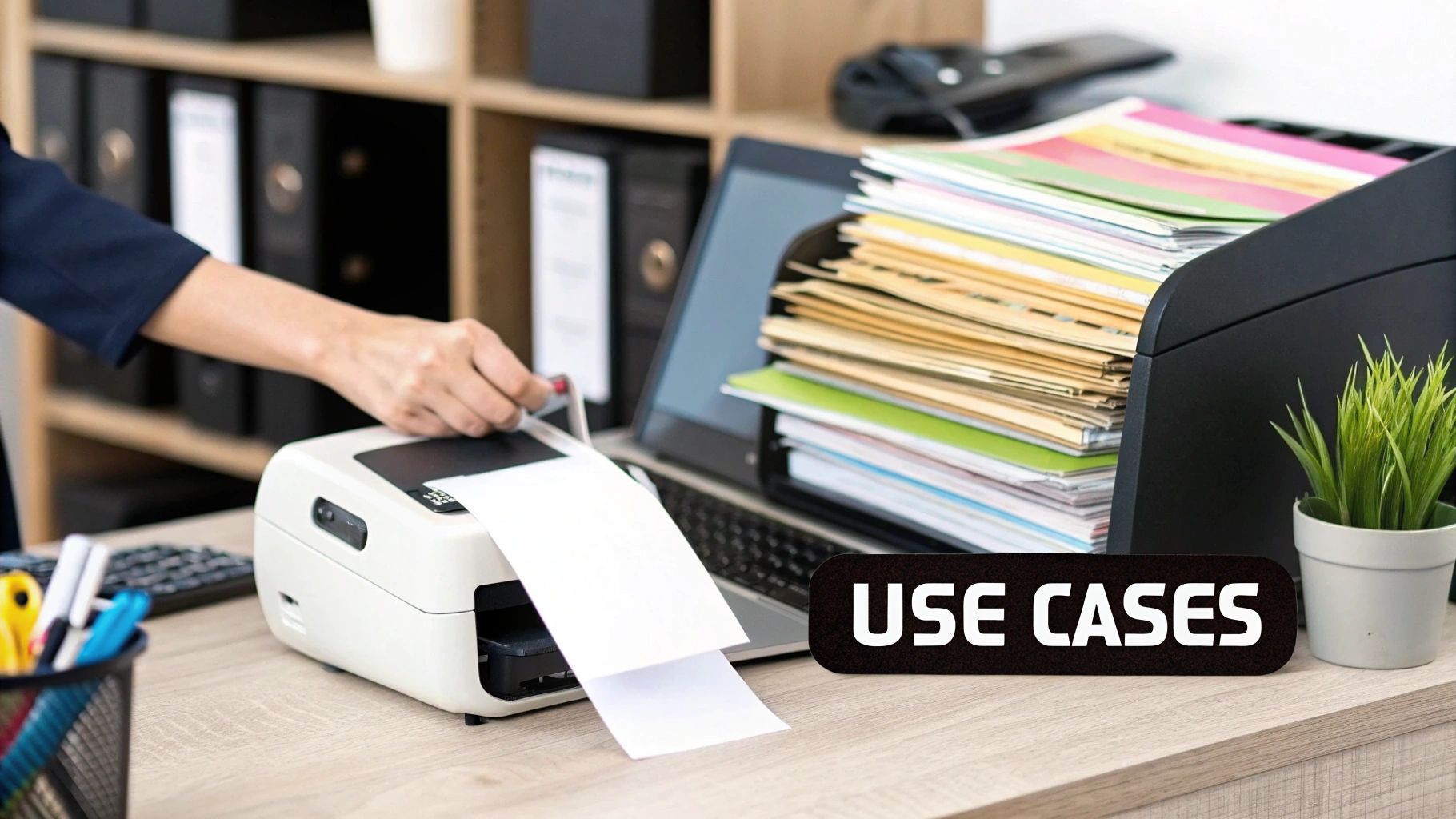
Picture a warehouse operative receiving a new shipment. Armed with a handheld device, they can immediately tag each pallet with a barcode detailing the product, arrival date, and its designated bin location. That single action prevents stock from getting lost and speeds up the entire put-away process.
It’s the same on the shop floor. A retail assistant can quickly fix a mislabelled shelf or print new markdown tags for a flash sale without ever leaving the aisle. All that time saved walking back and forth to a central office printer really adds up, leading to some serious productivity gains. One of the biggest wins here is the ability to automate repetitive tasks, freeing up your people for more important work.
Human error is an ever-present challenge with manual data entry and labelling. A misplaced decimal point or a misread product code can throw your inventory into chaos, and tracking down the source is a nightmare. Handheld label printers help tackle this head-on by linking directly to your business systems.
By printing labels directly from a verified data source-like a work order or inventory database-the chance for manual input errors drops dramatically. This creates a more reliable single source of truth for your stock.
This level of accuracy is very important for regulatory compliance. For industries with stringent labelling rules, like food and beverage or chemicals, you can generate fully compliant labels on the spot. This sees that every single item meets the required standards before it goes anywhere near the next stage of the supply chain.
The initial investment in handheld printers quickly pays for itself by cutting down operational delays and smoothing out your workflow. Fewer errors mean less time wasted on costly stocktakes and fewer expensive shipping mistakes.
The market certainly reflects this value. Globally, the handheld label printer sector was valued at USD 0.08 billion in 2024 and is projected to hit USD 0.12 billion by 2033. This growth, especially noticeable here in the UK, got a major push from the pandemic, which created a huge demand for on-site safety and organisational labelling across countless sectors.
These devices are a key part of any modern, efficient operation, working hand-in-glove with larger systems. If you’re curious about how these tools fit into the bigger picture, you might find our guide on labelling machines enhancing productivity in manufacturing insightful.
It’s one thing to talk about features, but the real test of a handheld label printer is how it performs out in the field. When you see these devices solving specific, everyday problems across different sectors, their value becomes crystal clear. They’re more than just a tool; they’re a direct solution to operational headaches, whether on a shop floor or in a meticulously organised warehouse.
The adoption of these printers in the UK has been remarkable, with nearly 510,000 units sold as of 2025. It’s telling that around 52% of these found a home in the retail sector, a clear sign of how much consumer-facing businesses depend on on-the-spot labelling. You can dig deeper into this trend with this report on the handheld label printer market.
In any warehouse, efficiency is the name of the game. A handheld label printer has become a cornerstone of modern logistics, empowering workers to manage stock with speed and precision.
A handheld printer in a warehouse is like giving each worker their own mobile admin station. It closes the gap between seeing a problem and fixing it, drastically cutting down on wasted footsteps and potential mistakes.
This ability to act immediately keeps the entire supply chain responsive and inventory moving smoothly, from goods-in to dispatch.
On the shop floor, presentation and speed are everything. Handheld printers give staff the agility to manage pricing and product information in real-time, often right in front of customers.
Think about a sudden flash sale. An assistant can simply walk the aisles, printing new markdown stickers for specific items without disrupting shoppers. If a shelf-edge label is damaged or missing, a replacement can be printed and fitted in seconds. It’s a world away from the old days of scrawling temporary signs or waiting for a batch print run from the back office.
In a manufacturing environment, clear identification is not just helpful-it’s critical for quality control and traceability. Handheld printers allow workers to label components and work-in-progress items as they move down the production line. A technician can tag a sub-assembly with a unique serial number, creating a breadcrumb trail that can be followed throughout its entire lifecycle. While these mobile devices excel at on-the-spot tasks, you can learn more about larger-scale solutions in our guide to choosing the perfect labelling machine for jars.
In healthcare, there is absolutely no room for error. Here, handheld printers play a significant role in keeping patients safe and making certain samples are handled correctly.
In every one of these scenarios, the humble handheld label printer provides a direct, practical solution that boosts accuracy, saves time, and helps staff to do their jobs better.
A handheld label printer is a powerful tool, but it’s only ever as good as the labels you feed it. Getting the label media right is absolutely critical. It directly affects the durability, readability, and overall lifespan of your entire labelling system. A mismatch here can lead to peeling, smudging, or unreadable barcodes, which completely defeats the purpose of your investment.
Think of it like choosing the right tyres for a car. You would not put standard road tyres on an off-road racer, and the same logic applies here. For reliable performance, the label itself has to be tough enough for the job at hand.
Your first, and most significant, decision is the label material. Each type offers a different mix of cost, durability, and resistance to whatever the world throws at it.
Paper Labels
These are your everyday, cost-effective workhorses. They’re perfect for general-purpose, indoor jobs where extreme longevity is not the goal. We’re talking shelf-edge labels in a climate-controlled shop or temporary shipping labels on cardboard boxes. Their biggest weakness? They do not stand up well to moisture, chemicals, or abrasion.
Polypropylene Labels
Taking a step up from paper, polypropylene is a synthetic material with good resistance to water, oils, and some chemicals. This makes it a fantastic choice for labelling products that might get damp, like food and drink containers or bathroom products. They are much more durable than paper, but they can struggle with extreme temperatures or harsh chemical exposure.
Polyester Labels
When you need a label that can survive the toughest industrial environments, polyester is what you reach for. It’s incredibly durable and can handle extreme temperatures, long-term UV exposure, and contact with harsh chemicals. This resilience makes it the perfect material for long-term asset tracking, marking outdoor equipment, and creating compliance labels in factories.
The core principle is simple: match the label’s resilience to the challenges it will face. A paper label on an outdoor generator will fail within days, whereas a polyester label might be overkill for a file folder.
The adhesive is the unsung hero that keeps your label stuck in place. Its properties are just as crucial as the label material itself. The wrong glue can mean labels fall off too soon or are impossible to remove when you actually need to.
You’ll generally come across three main types:
Picking the right combination of material and adhesive is a deep topic, and getting it right is fundamental to your success. For a more detailed walkthrough, you can explore our complete guide on how to choose labels for your industry in 2025. By carefully thinking about both these elements, you’ll build a labelling system that stays reliable and effective for years to come.
It’s completely normal to have questions when you’re thinking about bringing new equipment into your business. So, let’s tackle some of the most frequent queries we hear about handheld label printers to help you understand what they can do and how they might fit into your workflow.
This is a great question, and the answer really boils down to one thing: how long you need your label to last.
Think of thermal direct printing as a bit like an old-fashioned fax machine. It uses special heat-sensitive paper that turns black when the printhead gets hot. There’s no ink, toner, or ribbon involved, which keeps things simple. This makes it perfect for things with a short shelf life, like shipping labels or receipts, where you do not need the print to last for years. The trade-off is that these labels can fade if they’re left in the sun or exposed to heat.
Thermal transfer printing is a different beast entirely. It uses a heated printhead to melt a ribbon of wax or resin directly onto the label itself. This creates a sharp, incredibly durable print that stands up to fading, moisture, and even chemicals. It’s the go-to method for any application where resilience is non-negotiable-think product ID labels, compliance labelling, and asset tags that need to last for the long haul.
Modern handheld label printers are designed to play nicely with the other hardware you already use. They typically offer a few different connection options.
The best connection for you depends on where and how your team will be using the printer.
Absolutely. In fact, a huge number of handheld printers are built specifically for the rough-and-tumble environment of a warehouse or factory floor. The key is to check the device’s durability specs before you buy.
One of the most important metrics is the IP (Ingress Protection) rating. This tells you how well the device is sealed against dust and water. An IP54 rating, for example, means the printer is protected from most dust and can handle splashes of water from any direction. Another spec to look for is the drop test rating, which tells you the height from which the printer can be dropped onto concrete without breaking.
For a tough environment, look for printers with rubberised bumpers, rugged casings, and solid IP ratings. These features are built for the reality of daily knocks, drops, and exposure to dust that are common in industrial settings.
Yes, you certainly can. Virtually all handheld label printers come with their own label design software. This could be a simple app on your phone or a more powerful programme that runs on a desktop computer.
This software gives you total freedom to design your labels. You can set up custom layouts, add text and your company logo, and generate all sorts of barcodes, from standard linear ones to QR codes. This flexibility means you can create labels that meet very specific operational needs or match your company’s branding, all designed on your device and printed instantly.
Finding the right labelling solution means partnering with an expert who understands your industry’s demands. At Sessions UK, we provide a full range of high-performance labelling machinery and offer dedicated support to get the perfect fit for your production needs. Explore our labelling solutions today.

Learn how an RFID clothing tag can streamline retail operations and boost inventory accuracy. Discover benefits and implementation tips today.

Discover how asset tracking labels work for UK businesses. This guide covers barcode vs. RFID, materials, and how to build your asset management system.

A practical guide to labelling glass jars. Learn about machines, adhesives, and UK compliance to get a professional finish for your products.
Copyright © 2026 Sessions Label Solutions Ltd.