Automatic Label Applicator Machines for Bottles, Vials and Tubes
SessionsUK | 21st Jul 2025
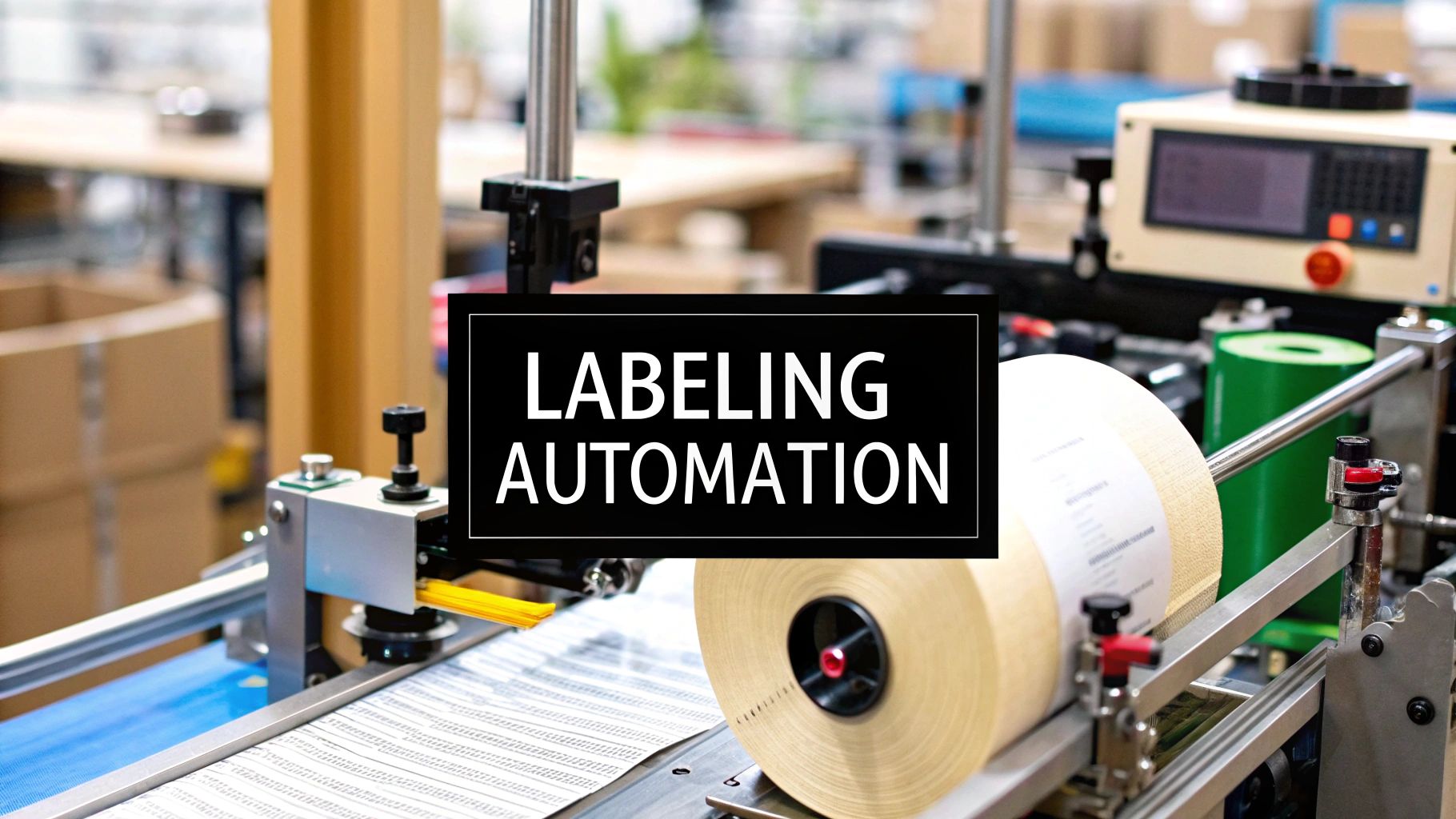
An automatic label applicator is a machine built to apply labels to products, containers, or packages without any manual intervention. It's best to think of it as a dedicated, highly precise worker on your production line-one that makes sure every single item gets a perfectly placed label, every time. For any business looking to scale up its operations, this kind of equipment is fundamental.
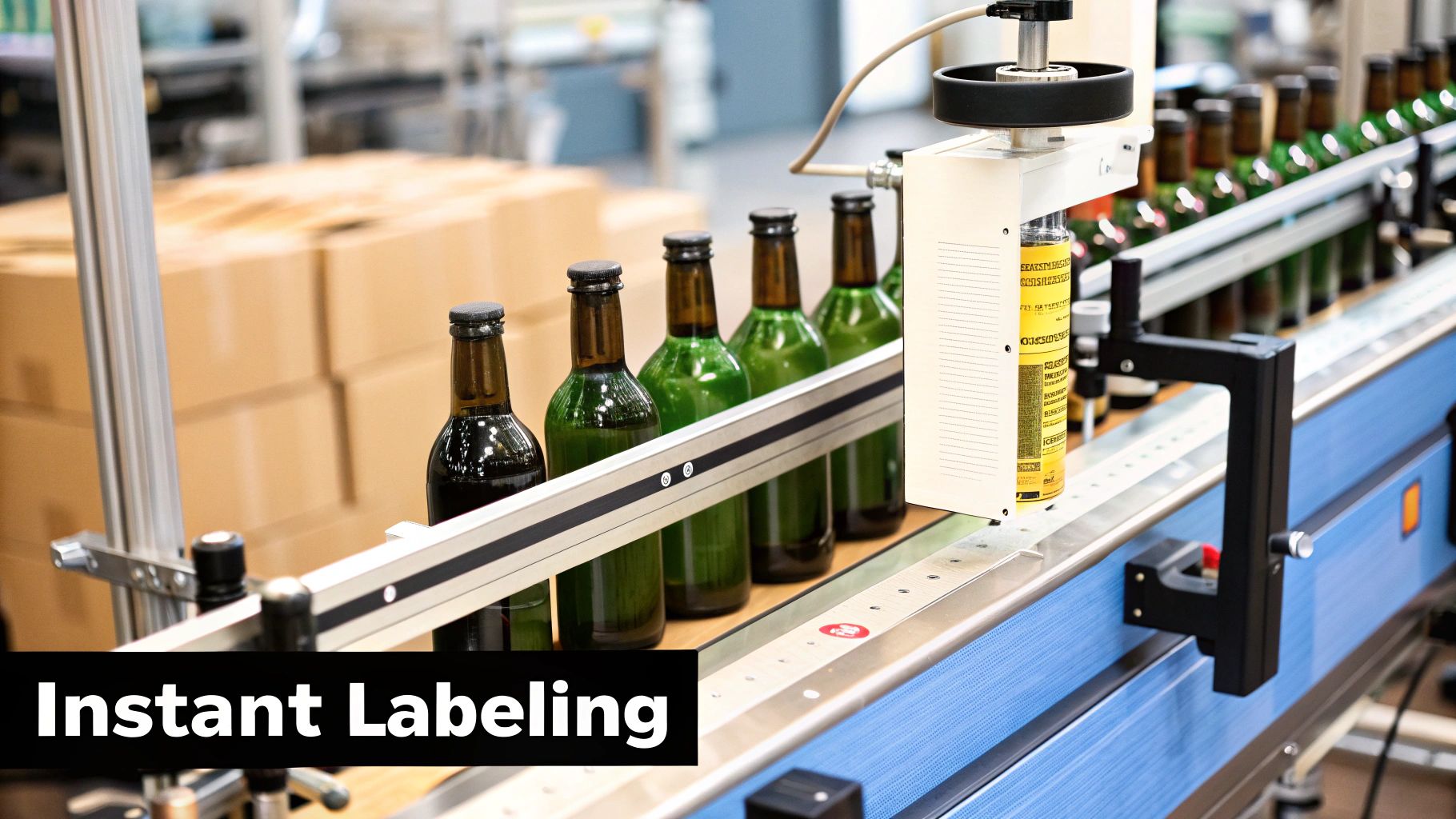 At its heart, an automatic label applicator is designed to take over a repetitive and often mistake-prone task. In any manufacturing or packaging environment, consistency is absolutely king. Labelling by hand can easily lead to crooked labels, inconsistent placement, and a much slower production pace, all of which can damage your brand's image and hamstring efficiency. This is exactly where automated systems come in.
By mechanising the application process, these machines deliver a level of uniformity at speeds simply impossible for a human to sustain. For many UK businesses, making the switch from manual to automated labelling represents a massive leap forward in professionalising their entire production process.
At its heart, an automatic label applicator is designed to take over a repetitive and often mistake-prone task. In any manufacturing or packaging environment, consistency is absolutely king. Labelling by hand can easily lead to crooked labels, inconsistent placement, and a much slower production pace, all of which can damage your brand's image and hamstring efficiency. This is exactly where automated systems come in.
By mechanising the application process, these machines deliver a level of uniformity at speeds simply impossible for a human to sustain. For many UK businesses, making the switch from manual to automated labelling represents a massive leap forward in professionalising their entire production process.
 As you can see, there’s a solution for almost any operational scale. But let's look into the core methods these machines use to apply the labels.
Each method has its place on the production line. The key is knowing which one aligns best with your needs, making certain you get a clean, professional finish every single time.
 Before you even start looking at brochures or talking to sales reps, the first step is to look inwards. You need a crystal-clear picture of your own operation and what you’ll be asking the machine to do, day in and day out.
For expert guidance on selecting and integrating the perfect Sessions UK labelling machine for your business, explore our full range of labelling machinery.
What Is an Automatic Label Applicator
At its heart, an automatic label applicator is designed to take over a repetitive and often mistake-prone task. In any manufacturing or packaging environment, consistency is absolutely king. Labelling by hand can easily lead to crooked labels, inconsistent placement, and a much slower production pace, all of which can damage your brand's image and hamstring efficiency. This is exactly where automated systems come in.
By mechanising the application process, these machines deliver a level of uniformity at speeds simply impossible for a human to sustain. For many UK businesses, making the switch from manual to automated labelling represents a massive leap forward in professionalising their entire production process.
The Core Purpose of Automation
An automatic label applicator is not just about going faster; it is about embedding precision and reliability into your workflow. These machines are engineered to tackle high-volume tasks while holding a standard of quality that is incredibly difficult to maintain manually. The real-world benefits are clear:- Increased Throughput: Some systems can apply labels to hundreds or even thousands of products per minute, directly boosting your production capacity.
- Improved Accuracy: Every label lands in the exact same spot, which is critical not just for brand aesthetics but also for barcode scannability.
- Reduced Labour Costs: Automating this job frees up your team to handle more complex responsibilities, cutting down the need for dedicated manual labellers.
- Minimised Errors: The risk of human error-like applying the wrong label or putting it on upside down-is virtually eliminated.
From Small Batches to Large-Scale Production
The need for an automatic label applicator usually becomes apparent as a business starts to grow. A small start-up might get by with applying labels by hand, but as soon as order volumes climb, this manual step quickly becomes a serious production bottleneck. An automatic system is the perfect solution, allowing companies to meet rising demand without letting quality slip.A well-implemented labelling system transforms a production line from a series of disjointed steps into a fluid, continuous operation. It is a foundational piece of equipment for any serious manufacturing venture.Keeping these systems in top condition is surprisingly straightforward, and knowing how to keep your fully automatic labelling machines running smoothly is key to getting the most out of your investment. With the right machine, businesses in sectors from food and beverage to pharmaceuticals can make certain their products leave the factory looking professional and ready for the shelf. It is a technology that forms a crucial part of modern, efficient supply chains across the United Kingdom.
How Automatic Label Applicators Work
Think of an automatic label applicator as a finely tuned orchestra on your production line. It is not just one action; it’s a sequence of perfectly timed movements that result in a perfectly placed label, happening over and over again with incredible speed and precision. It all starts the moment a product glides into the applicator's zone on a conveyor. A small sensor, like a gatekeeper, detects the product and sends a signal: "We've got one, get ready!" This single electronic pulse kicks the entire machine into gear. The first thing that happens is the drive system whirs to life, pulling just one label forward from a massive roll. This has to be exact - too much or too little pull, and you'll get a jam.The Core Mechanical Sequence
At the very heart of the machine is the clever way it separates the sticky label from its backing paper. This is all down to a simple but brilliant component called a peel plate (or sometimes a peel bar). As the roll of labels is pulled sharply over this thin, angled edge, the flexible backing paper bends away. The label itself, being a bit stiffer, keeps going straight, lifting cleanly off the liner. It’s the same motion you use when peeling a sticker by hand - you bend the paper back to pop the sticker’s edge up. The peel plate just automates that simple flick of the wrist, doing it flawlessly every time. The label is now held in place, adhesive side out, waiting for its product. Meanwhile, the now-useless backing paper is neatly wound onto a take-up spool, ready for disposal. The final step is the transfer. An applicator head moves in to place the label onto the product. Depending on the machine, this can happen in a few different ways:- A tamp pad gently presses the label onto the surface. Simple and effective.
- An air-jet or blow-on system shoots a precise puff of air, floating the label onto the product without any physical contact. This is ideal for delicate items or uneven surfaces.
- A wipe-on roller smoothly applies the label as the product moves past, essentially rolling it on.
Standard Applicators vs Print-and-Apply Systems
When you're looking into automatic labellers, you’ll quickly find they fall into two main camps: standard applicators and print-and-apply systems. Choosing the right one is critical and depends entirely on what information your labels need to show.A standard automatic label applicator is designed to work with pre-printed labels. The rolls you load into it already have all the branding, text, and barcodes printed on them.This setup is perfect when you’re applying the exact same label to thousands of products. Imagine a craft brewery canning its flagship IPA; every can gets the same beautiful, branded label. For high-volume runs where the information never changes, a standard applicator is the most straightforward and cost-effective choice.
When Dynamic Data Is Needed
A print-and-apply automatic label applicator has a built-in thermal printer. This is a big deal. It prints variable, unique information onto each label just seconds before applying it. This is absolutely necessary in industries like logistics. Every package leaving a warehouse needs a label with a unique address, a distinct tracking barcode, and specific shipping details. A print-and-apply system creates that label on demand. Other common uses include:- Food Production: Printing unique "best before" dates, batch codes, or weights for packaged goods.
- Pharmaceuticals: Adding serial numbers and lot codes to meet strict traceability regulations.
- Manufacturing: Applying unique part numbers or custom configuration details to components.
A Closer Look at Automatic Labelling Machine Types
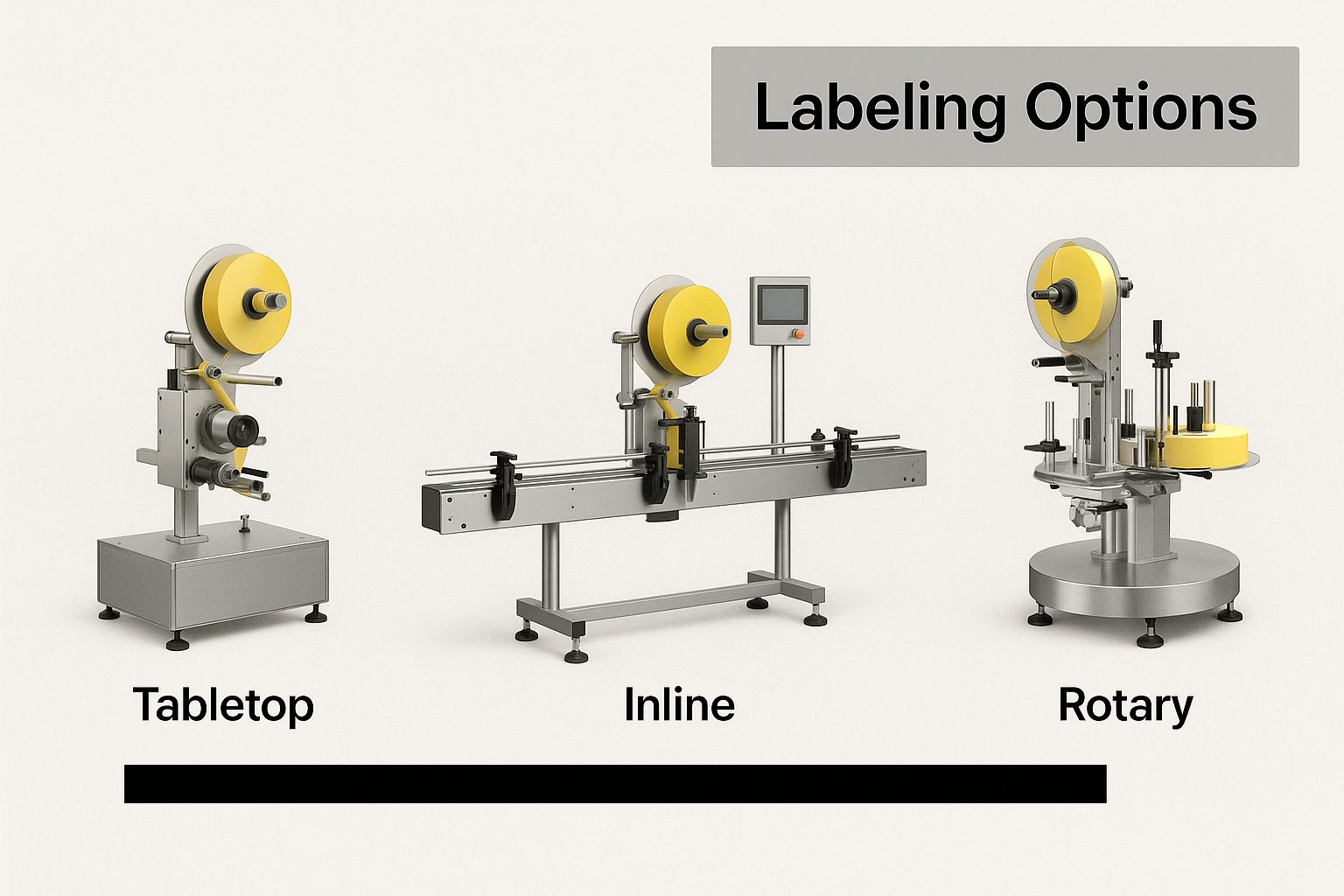
Choosing the right automatic label applicator isn't a one-size-fits-all decision. To get it right, you need to match the machine’s mechanics to your specific product and production line. The main point of difference between them is how they actually get the label from the machine onto your product. This image gives you a great visual idea of the different shapes and sizes these machines come in, from compact tabletop units to full-scale inline systems for busy production floors.
As you can see, there’s a solution for almost any operational scale. But let's look into the core methods these machines use to apply the labels.
Comparison of Automatic Label Applicator Types
To help you get a clear picture, this table breaks down the three primary application methods. Think about your product's shape, fragility, and the speed you need to run at as you review the options.| Applicator Type | Application Method | Ideal For | Key Advantage |
|---|---|---|---|
| Wipe-On | A brush or roller physically presses the label onto a moving product. | Flat or slightly curved surfaces like boxes, pouches, and jars. | High speed and reliability for consistent surfaces. |
| Air-Blow | A jet of compressed air blows the label onto the product from a short distance. | Delicate items or products with uneven or recessed surfaces. | Completely contactless application, preventing product damage. |
| Tamp-Blow | A pad moves near the product, then a puff of air applies the label. | Precise placement on specific spots or into recessed areas. | Excellent accuracy and placement control. |
Wipe-On Applicators
The wipe-on applicator is the trusted workhorse of the labelling world. It’s one of the most common and straightforward designs, and for good reason-it’s incredibly effective. As your product travels along a conveyor, the machine dispenses a label directly into its path. A roller or soft brush immediately follows, firmly wiping the label down. This action makes certain it adheres smoothly and securely, pushing out any potential air bubbles or wrinkles. Because of this direct contact, the wipe-on method is perfect for labelling sturdy products with flat or gently curved surfaces, like boxes, flat-sided bottles, and cartons. Its major advantage is its speed and reliability on consistent surfaces, making it a go-to for many high-volume packaging lines. The only real drawback is that the physical contact isn't suitable for very delicate items or for placing labels into recessed areas.Air-Blow Applicators
What if your products are fragile or have an awkward shape? That’s where an air-blow (or blow-on) applicator comes in. This clever system offers a completely contactless way of labelling. Here’s how it works: the label is peeled from its backing liner and held gently by suction on an applicator grid. A sensor detects the product as it passes, triggering a sharp, precise puff of compressed air. This air-jet propels the label across a small gap, placing it perfectly onto the product’s surface.This contactless approach is a big deal for delicate items or products with uneven surfaces, where a physical roller could cause damage or apply the label incorrectly.Since there are no moving parts in the applicator head itself during the cycle, wear and tear is kept to a minimum. It’s a fantastic choice for high-speed lines where product shapes might vary.
Tamp-Blow Applicators
The tamp-blow applicator is a smart hybrid, combining the precision of a tamping action with the gentle touch of air-blow. It gives you the best of both worlds. A flat pad, called a tamp pad, is mounted on a pneumatic cylinder. The machine extends this pad towards the product, stopping just a few millimetres away without ever making contact. Once it’s in position, a jet of air blows the label from the pad and onto the product. This method provides outstanding placement accuracy, making it the ideal solution for applying small labels to very specific locations or for neatly placing labels into recessed areas on packaging. For businesses just starting to automate, exploring the benefits of semi-automatic labelling can be a great first step before moving up to these more advanced, fully-automated systems.Specialised Labelling Systems
Beyond these core methods, you'll find many machines designed to tackle very specific packaging challenges.- Front-and-Back Applicators: These systems use two applicator heads to label both the front and back of a product (like a wine bottle or jar of sauce) in a single pass.
- Wraparound Applicators: Built for cylindrical products like bottles, cans, and vials, these machines use a special belt to roll a single label smoothly around the entire container.
- Top-and-Bottom Applicators: Just as the name implies, this setup applies labels to the top and bottom of a package at the same time, often used for food products in clamshell containers.
Which Industries Use Automated Labelling?
An automatic label applicator is far more than just another piece of equipment; it's the engine driving efficiency and precision across a surprisingly wide range of UK sectors. These systems are the unsung heroes working behind the scenes, from the food on our dinner tables to the medicines in our bathroom cabinets. They do much more than just stick on a label-they solve specific, critical problems for each industry they serve. This technology has become fundamental wherever speed, accuracy, and compliance are paramount. Its widespread adoption comes down to one simple fact: it directly tackles major operational headaches like human error, slow production speeds, and the ever-growing burden of regulatory standards. Let's take a closer look at a few of the key industries where these machines have become absolutely indispensable.Food and Beverage Production
The food and beverage industry is a world of massive volumes and razor-thin margins. In this environment, an automatic label applicator is not just helpful; it's necessary for keeping pace and meeting strict food safety laws. Just picture a busy bottling plant or a ready-meal production line-trying to label everything by hand would create an impossible bottleneck. These machines effortlessly manage several necessary tasks:- Applying Date Codes: "Best Before" and "Use By" dates are a legal must-have. Automation makes certain this information is printed clearly, correctly, and applied to thousands of items an hour without a hitch.
- Nutritional Information: Wraparound labellers are perfect for applying large labels packed with ingredients, allergen warnings, and nutritional facts onto jars, bottles, and packets in one smooth motion.
- Promotional Stickers: Need to add a "3 for 2" or competition sticker? An applicator does it instantly, avoiding any extra manual work that would just slow things down.
Pharmaceutical and Medical Sectors
In the world of pharmaceuticals, there is simply no room for error. A single misplaced or misprinted label can have devastating consequences. This is why the pinpoint precision of an automatic label applicator is less of a convenience and more of a critical compliance tool.The entire focus here is on absolute accuracy and traceability. Every label must be flawless, carrying information that is necessary for patient safety and regulatory oversight.Pharmaceutical applicators are often highly specialised, built to handle delicate, high-stakes tasks like:
- Serialisation: This involves applying a unique serial number to every individual medicine carton. It’s a key defence against counterfeit drugs and is mandated by regulations such as the Falsified Medicines Directive (FMD).
- Tamper-Evident Labelling: These systems carefully place security seals over carton flaps, providing clear visual proof if a package has been opened.
- Vial and Syringe Labelling: They excel at handling tiny, cylindrical containers that need small, perfectly placed wraparound labels.
Logistics and Warehousing
The logistics industry is the circulatory system of modern commerce. Its efficiency hinges on tracking millions of parcels quickly and accurately every single day. At the heart of any modern distribution centre, you’ll find a print-and-apply automatic label applicator. As packages speed down sorting conveyors, these systems print a unique shipping label and apply it in the blink of an eye. This label is a passport for the parcel, containing everything from the recipient's address and a scannable tracking barcode to crucial routing data. Without this level of automation, the promise of next-day delivery that we've all come to expect would be completely unachievable. The UK market certainly reflects these demands. The focus is on high-speed machines that can talk to warehouse management systems in real-time. For massive operations, like those in food and pharmaceuticals, some applicators are capable of labelling over 2,500 items per minute, keeping up with immense production volumes and strict hygiene rules. You can discover more about how technological integration is shaping the UK market for these applicators on marketreportanalytics.com.How to Select the Right Automatic Label Applicator
Choosing the right automatic label applicator is a major decision for any UK business aiming to get its production line running smoothly. Get it right, and you’ll see a massive boost in efficiency. Get it wrong, and you’ve just bought yourself a constant source of headaches and downtime. Think of this as your practical checklist, designed to help you ask the right questions and find the perfect machine for your needs.
Before you even start looking at brochures or talking to sales reps, the first step is to look inwards. You need a crystal-clear picture of your own operation and what you’ll be asking the machine to do, day in and day out.
Evaluate Your Production Needs First
It’s your product that really dictates the type of machine you need. It sounds obvious, but you’d be surprised. A labeller designed for flat cardboard boxes is going to be completely useless for labelling curved glass bottles. Start by getting the specifics down on paper.- Product Size and Shape: Are you labelling flat surfaces, cylinders, or something with an awkward, irregular shape? Do your products have recessed areas where the label needs to sit perfectly? List every single product type the applicator will need to handle.
- Label Type and Size: What are your labels made of - paper, vinyl, or a more specialised material? Jot down the exact dimensions. The machine has to be compatible with your specific label stock.
- Required Speed: How many products do you need to label per minute? Be honest about your current output, but also think about where you want to be in a year or two. This is your throughput target.
Key Machine and Supplier Factors
Once you’ve got a handle on your own requirements, you can start assessing potential machines and, just as relevantly, their suppliers. Look past the initial price tag and think about the total cost of owning and running the machine over its lifetime.- Integration with Existing Lines: How will this new piece of kit physically fit into your current setup? A good supplier will help you figure out exactly how it will connect to your existing conveyors, both mechanically and electrically.
- Ease of Use for Operators: A machine that’s a nightmare to operate will slow your team down and cause frustration. Look for a system with a simple user interface, straightforward controls, and quick, easy roll changes.
- Maintenance Requirements: Ask the nitty-gritty questions about routine upkeep. What needs doing, how often, and can your own team handle it? Knowing this upfront is a foundation for long-term reliability.
- Supplier Support: What kind of technical backup and training is on offer? Having a responsive, UK-based support team you can call on for troubleshooting or spare parts is absolutely invaluable.
A great supplier acts more like a partner. They should be focused on solving your production puzzle, not just shifting a box. Their expertise is what will guide you to the genuinely best solution for your business.It’s also wise to think about the future. Could the machine be adapted for different products or labels if your business pivots? Investing in a flexible system now could save you from having to buy a whole new machine in a few years. By exploring the many advantages of automatic labelling, you can build a solid business case for making this crucial investment. A well-informed decision today will pay for itself many times over in efficiency and reliability for years to come.
The Future of Automated Labelling Technology
The world of automated labelling is far from static. If you think today's applicators are impressive, the next wave is poised to be much smarter, more connected, and fundamentally more sustainable. These aren't just incremental updates; they're direct responses to the real-world demands of modern manufacturing for greater efficiency, total transparency, and genuine environmental responsibility. A massive driver behind this evolution is the push for intelligent packaging. Soon, a label won't just sit there displaying information; it will actively communicate. This is where technologies like Near Field Communication (NFC) and Radio Frequency Identification (RFID) technology are changing the game. By embedding these into labels, an automatic applicator gives every single product its own unique digital identity. Suddenly, you have a world of new possibilities. We're talking about tracking goods through the supply chain with pinpoint accuracy, offering customers interactive brand experiences with a simple phone tap, and creating powerful, hard-to-beat anti-counterfeiting measures.Artificial Intelligence and Machine Vision
Another huge leap forward is the integration of Artificial Intelligence (AI) and machine vision. Imagine an automatic label applicator that checks its own work. Future models will come equipped with high-speed cameras and smart software that can spot a slightly crooked label, identify a tiny printing error, or verify barcode readability in a split second. This isn't just a minor tweak. It shifts quality control from a separate, often manual, step into an integrated part of the labelling process itself. The result? A massive reduction in waste and the peace of mind that only perfectly labelled products are making it out the door. These AI-powered systems can also learn on the fly, automatically adjusting their settings for minor variations in products or labels, which cuts down on stoppages and the need for constant operator oversight.A Focus on Sustainability
Sustainability has moved from a "nice-to-have" to a core business principle, and this is having a profound impact on the design of the next generation of labelling machines. Applicator manufacturers are now engineering systems specifically to handle greener materials without a hitch. This includes working with:- Linerless Labels: These new labels do away with the backing paper, effectively slicing waste in half. Handling them requires specialised cutters and application methods to manage the continuously sticky roll.
- Thinner Materials: Using thinner label faces and liners is a simple way to reduce material consumption, but it demands machines with incredibly precise tension controls to prevent tearing or stretching.
- Recycled and Compostable Materials: As new eco-friendly label stocks and adhesives become available, applicators are being adapted to work with their unique properties seamlessly.
Frequently Asked Questions About Label Applicators
Thinking about investing in an automatic label applicator often brings up a few common questions. Getting these sorted out from the start is the best way to figure out if this technology is the right move for your UK operation and what to expect when it's up and running.What Is the Typical Speed of an Automatic Label Applicator?
This really depends on the machine you're looking at, the type of label, and how it's being applied. For smaller businesses or less demanding production lines, an entry-level machine will comfortably handle around 20-50 labels per minute. But if you're in a high-volume industry like bottling or pharmaceuticals, you'll be looking at high-performance systems that can fly through over 1,000 labels per minute. The trick is to match the applicator's speed to your production line's pace so it keeps things flowing smoothly instead of causing a jam.Can These Machines Handle Different Product Sizes and Shapes?
Absolutely. Versatility is a huge selling point for most modern labellers. You'll find that many come with adjustable guide rails, moveable sensors, and adaptable applicator heads, all designed to manage a variety of product shapes and sizes. That said, some machines are specialists, like wraparound labellers built just for bottles or front-and-back systems for boxes. It is always a good idea to chat with your supplier about everything you produce-and plan to produce-to make sure you get a machine that can grow with you.One of the most relevant things to think about is changeover time. How long does it take to switch from one product to another? A system that can be adjusted quickly and easily, without needing a box of special tools, will minimise downtime and keep your production line efficient.
How Difficult Is Integrating an Applicator into an Existing Production Line?
The integration process can range from incredibly simple to a bit more involved, depending on your current setup. Standalone applicators, for example, often just need to be wheeled up to your existing conveyor belt. It's a quick and easy way to get started with minimal fuss. For more complex systems that need to talk to your other machinery, you might need to make some physical adjustments to the line and wire it into your main control panel. To make life easier, look for applicators with flexible mounting options and standard communication ports. Many suppliers also offer full installation and integration services to get you going.What Maintenance Is Needed for an Automatic Label Applicator?
Keeping a label applicator in good shape is mostly about simple, regular checks. A little routine care goes a long way in making certain it runs reliably day in and day out. This typically involves:- Cleaning the sensors and rollers to stop sticky adhesive from building up.
- Keeping an eye on wear and tear for parts like the peel plate and drive belts.
- Making certain all the moving components are properly aligned.
For expert guidance on selecting and integrating the perfect Sessions UK labelling machine for your business, explore our full range of labelling machinery.