Material clothing labels might be small, but they carry a lot of weight. They're the silent storytellers of a garment, detailing everything from its fibre content and country of origin to the best way to care for it. This little tag is much more than just a brand name; it’s a critical element that builds trust with your customers and speaks volumes about your quality standards long after the item has left the shop.
Understanding the Purpose of Material Clothing Labels
Think of a material clothing label as a garment’s passport. It holds all the information that guides the consumer, protects your brand, and keeps you on the right side of the law. For shoppers, these labels answer the big questions: What am I really buying, and how do I look after it? For brands, they're a must-have for product presentation and legal compliance.
The role of these labels has changed quite a bit over the years. Here in the UK, their story really begins with the Merchandise Marks Act of 1887. This law made it mandatory for manufacturers to specify a product's material and origin, initially to prevent foreign goods from being passed off as British-made. This early piece of legislation set the stage for consumer protection and fair trade, shaping labelling rules across the globe. You can find out more about the history of clothing labels and their evolution to see just how far they've come.
Today, their purpose is even clearer, covering several key functions:
Information Delivery: Labels must clearly state the fabric composition, like 100% cotton or a specific polyester blend. This is helpful for customers who have allergies or are looking for particular material properties.
Care Instructions: They provide clear guidance on washing, drying, and ironing, which helps customers keep their clothes looking great and extends the garment's life.
Brand Identity: A thoughtfully designed label instantly communicates your brand’s commitment to quality and attention to detail, shaping how customers perceive your products.
Regulatory Compliance: Every label has to meet strict legal standards, disclosing specific information that’s required by law in the region where the item is sold.
A clothing label closes the loop between the maker and the wearer. It’s a pocket-sized source of truth that influences buying decisions, helps the product last, and helps build a solid brand reputation. Every single detail, from the material it’s made from to the text printed on it, adds to the overall experience.
Choosing Your Label Material
Picking the right material for your clothing labels is one of those small decisions that makes a huge difference. It’s a detail that quietly tells your customers a story about your brand’s quality, comfort, and character, often before they’ve even tried the garment on. The feel of that label against their skin, how sharp your logo looks, and whether it survives the wash-it all starts here.
Think about it: a scratchy, stiff tag on a soft babygrow just feels wrong. It sends a mixed message. That’s why getting the material right is critical for creating a consistent brand experience that resonates with your customers.
A Look at Common Label Materials
Different label materials bring their own unique strengths to the table. The best fit for your brand will come down to a mix of your overall aesthetic, the type of clothing you make, and your budget. Let’s break down some of the most popular choices.
This table provides a quick comparison of the most common materials, helping you see at a glance which one might suit your needs.
Comparison of Clothing Label Materials
Material
Feel & Texture
Durability
Best For
Perceived Value
Cotton
Soft, natural, slightly rustic
Good, but can fade or fray over time
Organic products, children's wear, casual apparel
Earthy, comfortable, approachable
Satin
Smooth, silky, gentle on the skin
Good, especially for printed designs
Lingerie, high-end t-shirts, items worn close to the skin
Elegant, comfortable, accessible luxury
Damask Woven
Smooth, with a dense, high-end feel
Excellent, withstands many washes
Luxury apparel, designer pieces, outerwear
Premium, sophisticated, high quality
Taffeta Woven
Stiffer, slightly crisp texture
Very durable, holds its shape well
Outer branding, care labels, budget-conscious projects
Functional, sturdy, economical
As you can see, each material projects a different feel. A soft cotton label instantly suggests natural comfort, while a finely woven damask label speaks to superior quality and meticulous detail. It’s all about matching the material to the message you want to send.
Practical Things to Consider
Beyond the look and feel, a few practical points will guide your decision. How a label performs over time is a big deal for customer satisfaction.
A key factor is durability against washing. Woven labels, especially high-density damask, tend to hold up much better through countless laundry cycles compared to some printed options, which can fade.
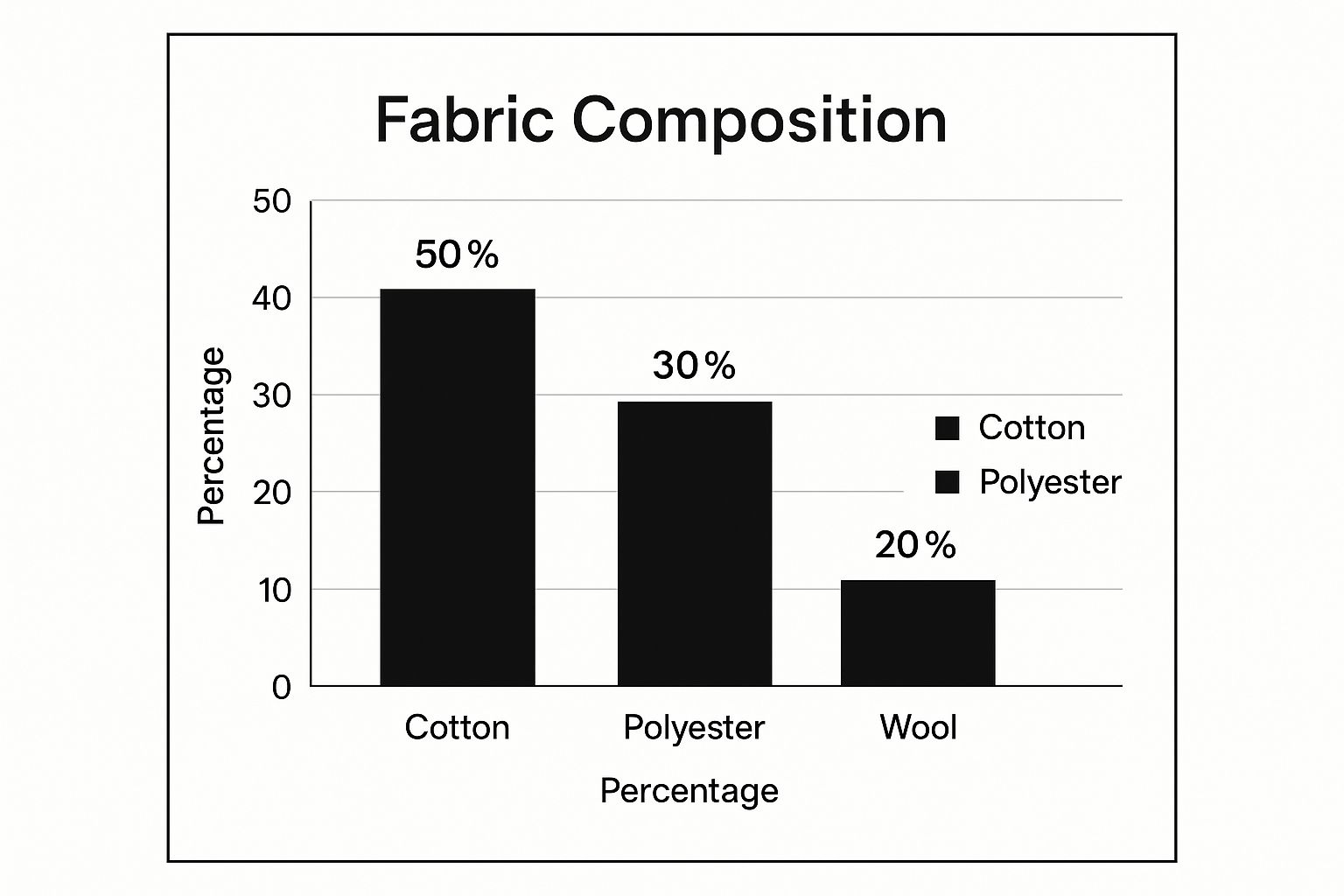
The data here shows that cotton and polyester blends are everywhere in the textile world. This makes it even more important to pick labels that work well with these common fabrics. For brands juggling different materials, understanding the ins and outs of label printing for clothing is a helpful step toward a professional, cohesive look.
Finally, don't forget comfort. For anything worn close to the body, like t-shirts or underwear, a softer material like satin or cotton is almost always the better choice over something stiffer like taffeta. It’s a small touch that shows you’ve thought about the entire wearing experience.
Label Construction and Application Methods
How a label is constructed and attached to a piece of clothing is every bit as important as the material it’s made from. These choices shape the final look, feel, and toughness of the label, which in turn says a lot about your brand's commitment to quality. When it comes down to it, you’re looking at two main paths: printed or woven labels. Each has its own place and purpose.
Printed labels are pretty much what they sound like. Ink is transferred directly onto a base material, typically something soft like satin or cotton. This method is brilliant for complex, colourful designs with tiny details, and it’s usually kinder on the budget. That’s why you’ll often find them on t-shirts or kids' clothing, where comfort against the skin and detailed graphics are key.
Woven labels are a different beast entirely. Here, threads are meticulously woven together to create both the label and the design within it. This process gives you a classic, premium finish that feels substantial and is built to last. For high-end fashion, heavy-duty outerwear, and any garment where you want the label to signal luxury and endure for years, woven is the way to go.
Printed vs. Woven Labels at a Glance
Feature
Printed Labels
Woven Labels
Best For
Intricate graphics, fine text, soft feel
Brand logos, classic look, high durability
Common Use
T-shirts, lingerie, care instructions
Outerwear, designer apparel, premium branding
Cost
More economical, especially for multi-colour designs
Higher initial cost, but excellent longevity
Durability
Good, but ink may fade over many washes
Excellent, as the design is part of the fabric
Choosing between printed and woven is a balancing act. You have to weigh your budget against your design's complexity and the feeling of quality you want to convey.
Understanding Label Folds and Placement
Once you've picked your label type, the next decision is how to fold and attach it. This isn't just a minor detail; it dictates the label’s role and how it sits on the finished garment. Different folds work best in different places, whether that’s the collar, the hem, or tucked away in a side seam.
A label’s fold isn't just a finishing touch; it’s a deliberate design choice that impacts wearer comfort and brand presentation. The right fold helps the label sit flat, remain secure, and interact with the garment as intended.
Some of the most common folding styles for material clothing labels you’ll see are:
End Fold: The ends of the label are neatly tucked under and then sewn onto the garment. This gives a very clean, polished look and is a popular choice for brand labels inside the neckline.
Centre Fold: The label is simply folded in half and caught in a seam, forming a loop. This is the go-to style for care and composition labels you find hidden in the side seams of shirts and trousers.
Mitre Fold: A bit more decorative, the ends are folded upwards at a 45-degree angle, creating little tabs that are then sewn down. You often see this on shirt hems or sleeve cuffs, where the label can hang like a small, stylish flag.
Getting the combination of construction and fold right is critical. Think about it: a high-quality woven label with a classic end fold at the neckline instantly creates a premium feel. A simple, printed, centre-folded care label delivers information discreetly without getting in the way. This kind of thoughtful approach helps your labels perfectly match your garment’s design, your budget, and your quality aspirations.
Meeting UK Clothing Label Regulations
Navigating the legal side of clothing labels is something every apparel brand in the UK has to get right. If you don't, you could be facing serious headaches like product recalls or fines, which is a situation no one wants to be in. At their core, these rules are here to protect consumers, making sure they know exactly what they’re buying.
The foundation of UK regulation is all about honesty and accuracy. Your material clothing labels must give people clear, correct information so they can make smart choices. This isn't just a nice-to-have; it's a legal must that builds consumer trust and product accountability across England, Scotland, and Wales.
Key Information Required on UK Labels
What absolutely has to be on the label? The single most important legal requirement is disclosing the fibre content. This is the cornerstone of UK textile labelling.
Fibre Content: You need to list every fibre in the garment, starting with the one that makes up the highest percentage and going down from there. A typical label might say "80% Cotton, 20% Polyester".
Animal-Derived Parts: If your product includes any non-textile parts from animals-think leather patches or fur trim-the label must explicitly state, "Contains non-textile parts of animal origin".
These rules are all about giving consumers the full picture. The official UK government guidance on textile labelling puts the responsibility for getting this right squarely on the shoulders of manufacturers and retailers. For the nitty-gritty details, you can always check out the UK government guidance on textile labelling.
Handling Complex Garments
What about more complicated items, like a jacket with a different lining? The regulations cover this clearly: you have to label the composition of each distinct part separately.
For a garment with a main body of 100% wool and a lining of 100% polyester, the label must list both components and their respective fibre contents. This prevents any confusion and helps the customer understand the entire product's makeup.
Getting this level of detail right is absolutely critical for staying compliant and earning customer trust.
Best Practices Beyond the Law
While fibre content is the main legal requirement, other details have become industry standards that customers fully expect to see. Leaving them off can hurt how people see your brand.
Care Instructions: Adding symbols for washing, drying, and ironing helps customers look after their clothes, which shows you care about your product's lifespan.
Country of Origin: Stating where the product was made is another piece of information that many modern consumers actively look for.
Sizing: Clear, consistent sizing is fundamental to a good customer experience. It helps cut down on returns and builds loyalty.
Keeping up with these regulations is a continuous process. For a closer look at how these rules are changing, our guide on understanding label regulations provides a 2025 outlook for production teams. By treating the legal minimums as your starting point and then adding useful, customer-first information, you can create labels that aren’t just compliant-they’re a genuine asset to your brand.
The Future of Sustainable and Digital Labels
The world of material clothing labels is undergoing a massive transformation. For years, labels were a simple afterthought, but now they're at the forefront of a movement driven by two powerful forces: consumer demand for transparency and a serious commitment to environmental responsibility. Brands are now looking far beyond just the feel or cost of a label. They’re thinking about the entire lifecycle of their products, and the label is becoming a key way to communicate their values.
This means we're seeing a major pivot towards sustainable and digital solutions. Eco-friendly materials, for instance, are quickly becoming the new normal. Instead of relying on virgin polyester, savvy brands are choosing organic cotton, recycled polyester (rPET), or even different options like bamboo and cork. It's a smart move that not only shrinks their environmental footprint but also proves to customers they're genuine about their green claims.
The Rise of Eco-Labelling and Transparency
This isn’t just a passing trend; it’s being cemented by new legislation. Across the UK and Europe, stricter regulations are forcing brands to be much more upfront about their environmental impact. New eco-label rules now require larger companies to disclose details, from a product's reparability and recyclability to the presence of microplastics.
This regulatory push directly answers the growing chorus of consumers demanding honesty. People want the full story: where did their clothes come from? How were they made? And what should they do with them when they're finished with them? A well-designed, sustainable label provides these answers right on the garment. You can learn more about the best practices for labelling and sustainability heading towards 2025.
This new regulatory scene is about more than just listing fibres. It demands a complete, honest picture of a product's journey, pushing for clear, verifiable claims about its real-world environmental performance.
Digital Product Passports and QR Codes
The next frontier is where the physical label meets the digital world. Digital Product Passports (DPPs) are about to become a major development, linking a garment to a vast repository of online information. All it takes is a quick scan of a QR code on the label to unlock an item’s entire history.
This is a phenomenal opportunity for brands to connect with their customers on a much deeper level. Imagine what a DPP could show you:
Supply Chain Journey: Trace the raw materials from the farm to the factory floor where the garment was stitched together.
Environmental Impact Data: See precise metrics on water consumption, carbon emissions, and chemical usage.
Repair and Recycling Guides: Get practical advice on how to care for your item, extend its life, or dispose of it responsibly.
This digital layer turns a humble clothing label into an interactive gateway. It gives people the knowledge they crave to make better choices and, in doing so, builds a foundation of trust with the brand. This blend of sustainable materials and digital innovation isn't just a possibility-it's the future of clothing labels.
Common Questions About Clothing Labels
When you're bringing a garment to life, a lot of practical questions pop up, especially around material clothing labels. For new brands, in particular, getting straightforward answers is key to getting the design right and staying compliant. Let's walk through some of the most common queries we hear.
What Is the Minimum Information Required on a UK Clothing Label?
At its core, the one absolute legal must-have on a UK clothing label is the fibre content. You need to clearly list the material composition, with each fibre presented in descending order by its percentage. A typical example would be something like "70% Cotton, 30% Recycled Polyester".
While things like care instructions and the country of origin aren't strictly required by law for every single product, they are absolutely considered best practice. Today's shoppers have come to expect this information. And remember, if you're selling online, these details must be visible to the customer before they hit the buy button.
Keep in mind that some items, like those containing fur or other animal-derived materials, have extra rules. When in doubt, it’s always better to be fully transparent. It’s how you build trust.
How Do I Choose Between Woven and Printed Labels?
The choice between a woven or a printed label really boils down to your brand's personality, the type of garment you're making, and your budget. Each one has its own strengths.
Woven Labels: Think of these as the classic, premium choice. They're made by weaving threads together, which gives them a durable, high-end feel. They are perfect for designer pieces, outerwear, or any item where you want the quality to speak for itself. Because the design is part of the fabric, it won't fade.
Printed Labels: These are made by printing ink directly onto a soft material like satin or cotton. This method is generally more budget-friendly, especially if you have a complex, multi-coloured logo. Their softer touch makes them ideal for clothing worn right against the skin-think T-shirts, activewear, and kids' clothes.
A good rule of thumb? Use woven labels for a lasting brand statement on higher-value items and go with printed labels for comfort and detailed graphics on everyday wear.
What Are the Benefits of Using Sustainable Label Materials?
Choosing sustainable materials like organic cotton or recycled polyester for your labels does more than just tick a box. It sends a powerful message about your brand's commitment to the environment, which is a massive deciding factor for a growing number of shoppers. It can be a genuine point of difference in a very crowded market.
Making this switch also helps reduce your brand’s overall environmental footprint. As consumers and regulators alike push for greater transparency, adopting sustainable practices now positions your business for the future. It’s a great way to build a loyal community of customers who share your values. If you're running into challenges, you can find answers to frequently asked questions about common labelling issues and how to solve them.
Can I Use Multiple Labels on a Single Garment?
Yes, absolutely! In fact, it's very common and often the most practical way to go. Using a few different labels on one piece of clothing lets you organise information clearly without sacrificing comfort.
A typical setup might look like this: a main brand label at the neckline, a separate care and content label tucked away on an inner side seam, and maybe a small size tag on another seam. This approach keeps the primary branding clean and visible while the detailed regulatory info is kept out of the way. It also lets you mix and match, maybe using a premium woven brand label with a simple printed care label to get the best of both worlds, balancing aesthetics with your budget.
Labelling something like this?
Tell us what you're labelling and we'll tell you which machine fits — or whether you need one at all.